Materials transport
Evaluate repeatable movements of supplies on an agreed flat-ground route. Define loading points, fixtures, access controls and human supervision.
D1 MAXPRO · HEAVY-LOAD LEGGED PLATFORM
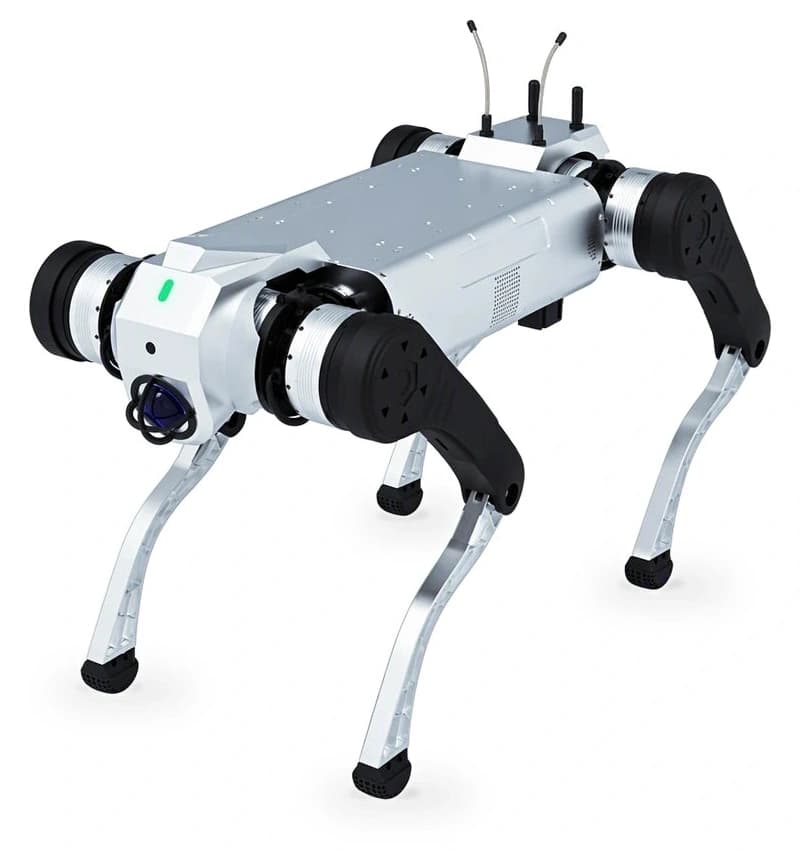
Put the load at the centre of the brief. Explore D1 MaxPro with HRS for UK materials transport, equipment carrying and supervised legged-robot trials.
PLATFORM FIT
Industrial legged platform for materials transport and equipment-carrying projects, with a manufacturer-rated continuous payload of up to 50 kg on flat terrain. Start with what needs moving, then assess the route and operating procedure.
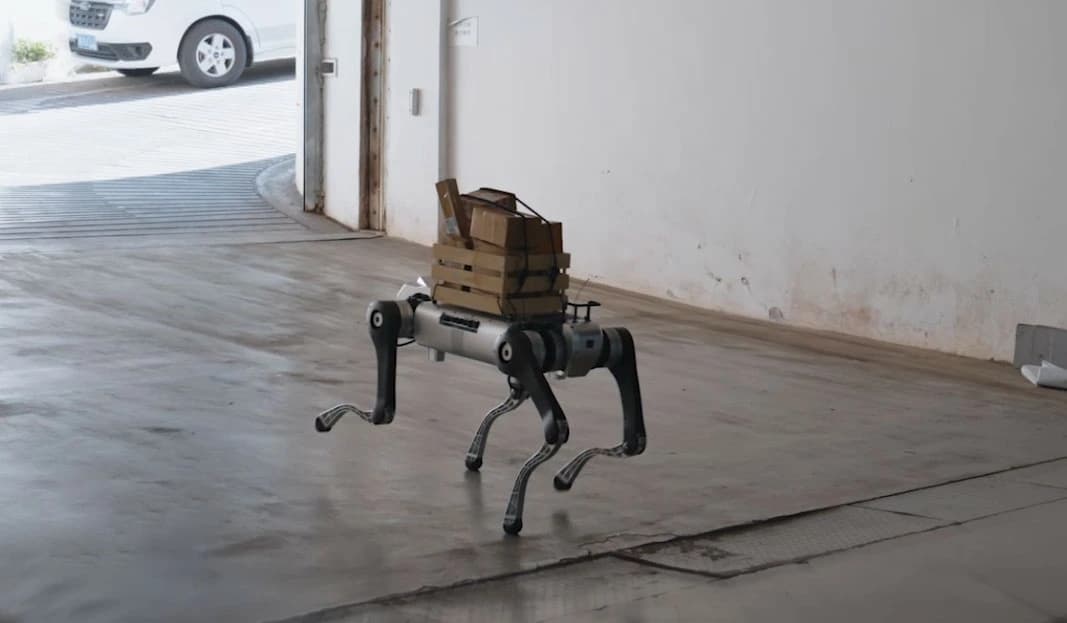
The continuous rating is up to 50 kg on flat terrain. Include fixtures and accessories, check load position and secure the payload using the manufacturer’s mounting procedure.
Three joints per leg give MaxPro 12 degrees of freedom. It is a larger legged carrier, distinct from the wheel-legged D1 Max. Choose the locomotion format around the route, rather than treating MaxPro as simply a faster Max.
Loading, travelling, unloading and charging all shape the task. Evaluate the loaded duty cycle and reserve battery capacity, not just the unloaded endurance figure.
CANDIDATE APPLICATIONS
Project directions to assess with HRS, each with its own payload, route and acceptance criteria.
Evaluate repeatable movements of supplies on an agreed flat-ground route. Define loading points, fixtures, access controls and human supervision.
Plan a carrier for equipment that needs to move between work areas. Assess the complete load, its centre of gravity and safe loading and unloading.
Assess separately specified equipment on the mounting platform. Check mechanical fixing, electrical supply and data connections before integration.
Develop and test load-aware motion and transport workflows using documented interfaces. Validate each surface and transition within a controlled test area.
SPECIFICATIONS
Manufacturer laboratory figures and operating limits. Payload, speed, stair height and endurance are separate ratings, not guaranteed simultaneous results. Practical performance depends on the load, terrain, motion profile, software, temperature and battery condition.
Sources: D1 MaxPro technical specification, English user manual, SDK guide and official product page.
AGIBOT rates unloaded runtime at 5.5 ± 0.5 hours. With a 50 kg load, the figure is around 2 hours. Charging the 2081 Wh pack from 10% to 90% takes around 4.5 hours.
The battery is replaceable. Plan a stopped changeover using the manufacturer’s procedure; do not treat it as the dual-battery hot-swap system used by D1 Max. An autonomous charging dock is optional and requires the appropriate setup.
The 50 kg continuous flat-terrain rating excludes stairs, rubble and steep ladders. AGIBOT specifies steps up to 30 cm and staircases up to 45° in Normal mode. Assess the actual geometry and permissible load before any stair trial.
D1 MaxPro must not carry people. IP67 is an ingress-protection rating, not hazardous-area certification or permission for immersion. Review connector protection and the complete fitted system.
SENSING & DEVELOPMENT
Front LiDAR, front and rear cameras and an IMU support sensing. The transport application, navigation setup and control logic still need to be defined.
AGIBOT documents mapping and navigation functions. Scope the software, mapping process, communications, route restrictions and operator oversight for the chosen site.
TCP and ROS interfaces are documented for x86 and ARM. Use the SDK that matches the supplied firmware, with appropriate state management and sufficient resources for robot operation.
Plan Ethernet, USB, serial and payload-power connections alongside the mounting design. Specify any cellular module, docking station or application equipment separately.
CHOOSE YOUR PLATFORM
Max combines wheels and articulated legs for industrial payload integration. MaxPro is a heavier legged platform with a larger flat-terrain load allowance. The sensor packages and batteries also differ.
| At a glance | D1 Max | D1 MaxPro |
|---|---|---|
| Degrees of freedom | 12 leg joints + 4 wheel hubs | 12 DOF · 3 per leg |
| Weight incl. battery | 41 kg | 68 ± 1 kg |
| Payload rating | 25 kg | Up to 50 kg · flat terrain |
| LiDAR | 2 × 96-channel LiDAR · front and rear | 1 × front-mounted 96-line LiDAR |
| Cameras | 2 × 8 MP FPV cameras · front and rear | 2 × 2 MP wide-angle cameras · front and rear |
| Battery configuration | 2 × 504.9 Wh · hot-swappable | 2081 Wh · replaceable pack |
| Ingress protection | IP67 | IP67 |
These are model-specific manufacturer ratings, not a like-for-like loaded-terrain test. Explore D1 Max for wheel-legged equipment integration, or compare the full Lingxi D1 range.
HRS SUPPORT
HRS can help assess platform fit and plan a supervised UK demonstration around a defined load and operating area.
Review mass, dimensions, fixtures, surfaces and loading points. Establish safety boundaries and measurable trial objectives.
Agree hardware, software, power, connectivity and optional accessories. Separate the base platform from the application integration.
Plan operator training, load handling, stopping procedures and battery changes. Define demonstration arrangements and ongoing support.
D1 MaxPro FAQ
AGIBOT D1 MaxPro is a heavy-load industrial quadruped in the Lingxi D1 family. It walks on four articulated legs with 12 degrees of freedom and weighs 68 ± 1 kg including its battery. HRS can assess it for UK materials-transport projects, equipment carrying and supervised industrial trials.
The manufacturer rates continuous payload at up to 50 kg on flat terrain. This rating excludes stair climbing, rubble and steep ladders. Include fixtures and accessories in the load assessment, secure the payload with the robot prone and follow the manufacturer’s loading procedure. D1 MaxPro must not carry people.
D1 MaxPro is a legged heavy-load platform with a continuous flat-terrain payload rating of up to 50 kg and a weight of 68 ± 1 kg. D1 Max is a wheel-legged platform with a 25 kg effective payload and a weight of 41 kg. MaxPro uses one front-mounted 96-line LiDAR and front and rear 2 MP cameras; Max lists two 96-channel LiDAR units and front and rear 8 MP FPV cameras. Choose by load, route and integration needs, not the model name alone.
AGIBOT specifies continuous steps up to 30 cm and a maximum staircase angle of 45°, using Normal mode. The continuous 50 kg flat-terrain payload rating does not apply to stairs. Review step geometry, surfaces, load, clearances and stopping arrangements for the proposed route before a supervised trial.
Manufacturer laboratory figures are 5.5 ± 0.5 hours unloaded and around 2 hours with a 50 kg load. The replaceable battery pack is rated at 2081 Wh; charging from 10% to 90% takes around 4.5 hours. Use the manufacturer’s replacement procedure and plan a stopped changeover, not uninterrupted hot-swap operation. Actual runtime depends on load, terrain, motion, temperature and battery condition. An autonomous charging dock is optional.
AGIBOT documents LiDAR-based mapping and navigation, plus TCP and ROS development interfaces for x86 and ARM systems. Match the SDK to the supplied robot firmware and scope the software package, mapping, communications and operator oversight for the task. The V0.2.5 guide recommends Ubuntu 20.04 and requires ROS 1 for low-level development; high-level TCP development does not require ROS 1. Sensor hardware and SDK access are not a ready-to-run unattended service.
AGIBOT specifies IP67 ingress protection and an operating-temperature range of −20 to 55°C. Outdoor suitability still depends on the site, surfaces, fitted equipment, seals and connector protection. IP67 is not a hazardous-area approval or permission for immersion. Assess the operating area and follow the manufacturer’s instructions before a trial.
Contact HRS with the load, route, site location and timing. We can assess the application and discuss a supervised UK demonstration, configuration planning, operator training and integration support. Hardware, software, accessories and availability are agreed during the enquiry.
YOUR NEXT STEP
Tell HRS about the load, route and timing. We can assess the requirements and discuss a supervised D1 MaxPro demonstration in the UK.