Inspection-payload integration
Assess a separately specified inspection sensor, mounting arrangement and data workflow on a mobile base. Check balance, power and communications before a site trial.
D1 MAX · INDUSTRIAL WHEEL-LEGGED PLATFORM
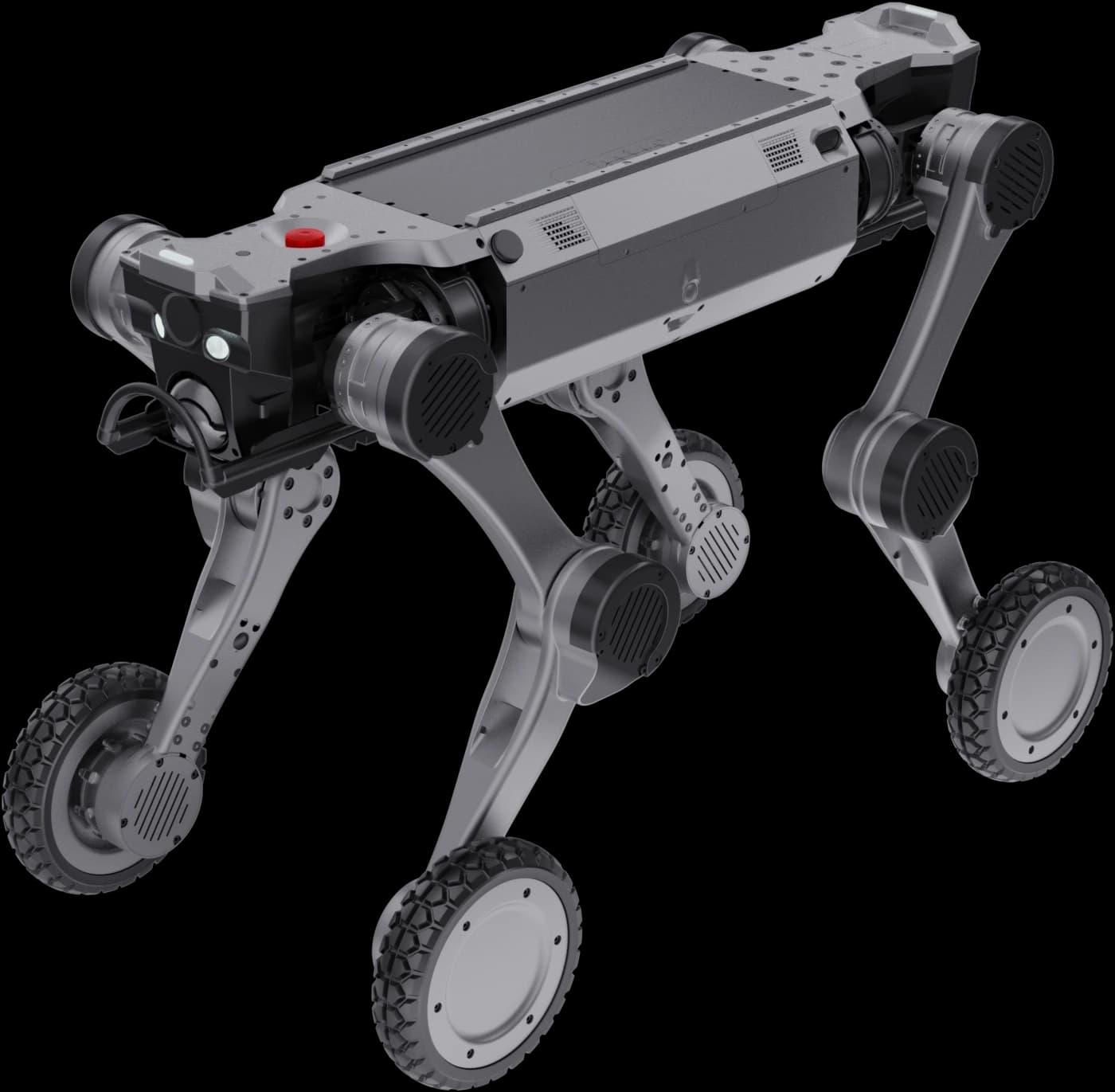
Build around the equipment your task needs. Explore D1 Max with HRS for UK inspection integration, equipment transport and supervised industrial trials.
PLATFORM FIT
Industrial wheel-legged platform for equipment transport and inspection integration, with a manufacturer-rated 25 kg payload, front and rear LiDAR, and dual hot-swappable batteries. Choose Max when the equipment, sensor package and operating environment call for a larger industrial base.
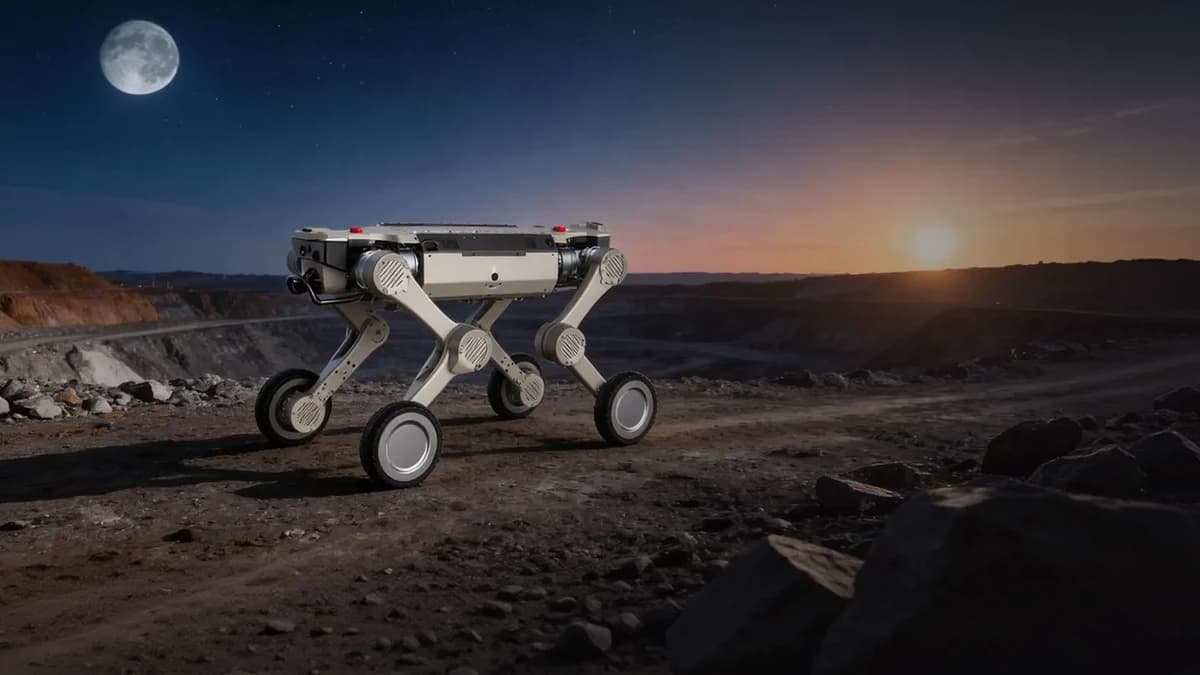
Start with the equipment and its mounting hardware, then check mass, position, power and data needs. The dedicated specification’s 25 kg effective payload is a planning limit, not a promise to carry any load across any terrain.
Front and rear 96-channel LiDAR and 8 MP FPV cameras are listed alongside RTK, an IMU and side ultrasonic sensors. Define the sensing and data requirements of the task, then confirm the software that will use them.
Twelve leg joints and four powered wheel hubs combine rolling motion with posture control. AGIBOT also documents interchangeable wheel and point-foot equipment; confirm the hardware kit and changeover procedure rather than assuming a software-only conversion.
CANDIDATE APPLICATIONS
Potential project directions for a configured platform, not claims of existing HRS deployments or a ready-to-run autonomous service.
Assess a separately specified inspection sensor, mounting arrangement and data workflow on a mobile base. Check balance, power and communications before a site trial.
Plan the movement of tools or equipment along an agreed route. Account for the complete load, secure mounting, stopping distance and supervised loading and unloading.
Evaluate repeatable observation routes using the fitted cameras and a defined operating area. Scope navigation software, mapping, human oversight and site permissions separately.
Develop payload interfaces and sensor-data applications using the documented SDK. Test the software and robot model against the supplied firmware before moving to field trials.
SPECIFICATIONS
Manufacturer laboratory figures. Payload, maximum speed, stair height, runtime and range are separate ratings, not results guaranteed together. Practical performance depends on the load, motion profile, terrain, software, temperature and battery condition.
Sources: D1 Max technical specification (English on page 2), English user manual, SDK guide and official product page.
The two 504.9 Wh packs support hot-swap using the manufacturer’s procedure. Unloaded runtime is 5 ± 0.5 hours; the full-load figure is 3.5 ± 0.5 hours. Plan realistic reserve capacity and battery handling around the actual task.
AGIBOT lists charging time as under 1.5 hours. A standard charger and an optional autonomous charging station are different items; plan the station, software, firmware and site setup if automatic docking is required.
The manual and SDK restrict a loaded robot to basic locomotion and exclude high-platform manoeuvres. The 25 cm continuous stair rating is not a guarantee for a loaded route. Review the complete payload, centre of gravity, clearances and stopping behaviour before testing.
IP67 describes ingress protection, not universal outdoor suitability or hazardous-area certification. Connector covers, seals, fitted equipment and operating conditions still matter.
SENSING & INTEGRATION
Max provides a sensor-equipped base and documented development interfaces. The application, navigation package and site integration still need a defined scope.
Use the specified Ethernet, USB and serial interfaces to plan equipment integration. Power outputs span 5, 12, 24 and 48 V, with a maximum 480 W total output across ports, not 480 W per port.
AGIBOT documents a C++ SDK, URDF files and ROS 2 sensor feeds. Confirm firmware compatibility, control permissions and resources reserved for robot operation; 157 TOPS is the listed compute rating, not spare capacity promised to an application.
SLAM mapping and navigation are optional SDK functions. Plan the software, licences, mapping process, route constraints and supervision for the application. Sensors alone do not deliver unattended patrol.
CHOOSE YOUR PLATFORM
Ultra-W is a more compact wheel-legged platform for mobility research and route evaluation. Max adds a larger payload allowance, base sensing and industrial interfaces for equipment-led projects. Neither is a substitute for a site-specific assessment.
| At a glance | D1 Ultra-W | D1 Max |
|---|---|---|
| Standing size (L × W × H) | 630 × 430 × 485 mm | 930 × 480 × 585 mm |
| Weight incl. battery | 22 kg | 41 kg |
| Effective payload | 5 kg | 25 kg |
| Maximum speed | Up to 3.7 m/s | Up to 6 m/s |
| Ingress protection | IP54 | IP67 |
For a smaller mobility-development project, read the D1 Ultra-W guide. For the rest of the range, explore the Lingxi D1 line.
For heavier flat-ground carrying tasks, compare Max with the legged D1 MaxPro. Its load rating and locomotion format differ; choose around the payload and route.
HRS SUPPORT
HRS can help assess the platform fit and scope a UK demonstration. Agree the supplied hardware, application work and support responsibilities before committing to a project.
Discuss the equipment, mounting, power and data needs. Define the route, people, surfaces and measurable acceptance criteria.
Confirm the hardware revision, software package, UK charging equipment and optional accessories. Separate base features from additional integration.
Scope training, battery handling, stopping procedures and supervised tests. Agree demonstration arrangements and ongoing support.
D1 Max FAQ
AGIBOT D1 Max is an industrial wheel-legged quadruped in the Lingxi D1 family. The dedicated specification lists 41 kg including batteries, a 25 kg effective payload, IP67 protection and NVIDIA Orin NX 16 GB compute. HRS can assess it for UK equipment-transport projects, inspection integration and supervised site trials.
Both combine articulated legs with powered wheels. D1 Max is the larger industrial platform: its dedicated sheet lists a 25 kg payload, 41 kg weight and IP67, compared with Ultra-W’s 5 kg, 22 kg and IP54. Max also lists front and rear LiDAR, RTK and Orin NX compute as base equipment. Ultra-W remains a more compact option for wheel-legged mobility research and route evaluation.
AGIBOT rates D1 Max’s effective payload at 25 kg. Include the mounting hardware and accessories in that allowance. With a payload fitted, follow the manufacturer’s restriction to basic locomotion; high-platform manoeuvres are excluded. D1 Max is not a passenger vehicle.
SLAM mapping and navigation are optional functions in AGIBOT’s D1 Max SDK, requiring compatible software, firmware and site setup. The base sensor suite comprises two 96-channel LiDAR units, two 8 MP FPV cameras, GNSS RTK, an IMU and side ultrasonic sensors. Plan the navigation package, mapping and supervision for the intended task; the sensors alone do not constitute an unattended patrol system.
Manufacturer laboratory figures are 5 ± 0.5 hours unloaded and 3.5 ± 0.5 hours at full load, with respective ranges of 29 ± 1 km and 18 ± 1 km. The two 504.9 Wh batteries support hot-swap using the manufacturer’s procedure. Manufacturer-rated charging time is under 1.5 hours. Actual results depend on duty cycle, terrain, equipment, temperature and battery condition. An autonomous charging station is optional.
AGIBOT documents a C++ SDK, URDF robot model files and ROS 2 sensor interfaces, alongside Ethernet, USB, serial and payload-power connections. Match the SDK to the supplied firmware and agree the control interfaces and available compute resources. Navigation and autonomous docking have additional software and hardware requirements; SDK access does not mean unrestricted access to every controller or all 157 TOPS for custom applications.
No. IP67 is the manufacturer’s ingress-protection rating, not an all-weather, immersion or hazardous-area approval. Check seals, connector covers and the effect of added equipment. Follow the manufacturer’s operating-temperature limits and review surfaces, people, communications and stopping arrangements before an outdoor trial.
Contact HRS with your proposed payload, route, power and data requirements, location and timing. We can assess the fit, discuss a supervised demonstration and scope configuration planning, operator training and integration support. Hardware, software, accessories and availability are confirmed during the enquiry.
YOUR NEXT STEP
Share the equipment, route and timing. HRS can assess the requirements and discuss a supervised UK demonstration.