Wheel-legged mobility research
Study the relationship between wheel motion, leg posture and the supporting surface. Confirm the model-specific control interfaces and simulation files before designing an experiment.
D1 ULTRA-W · WHEEL-LEGGED QUADRUPED
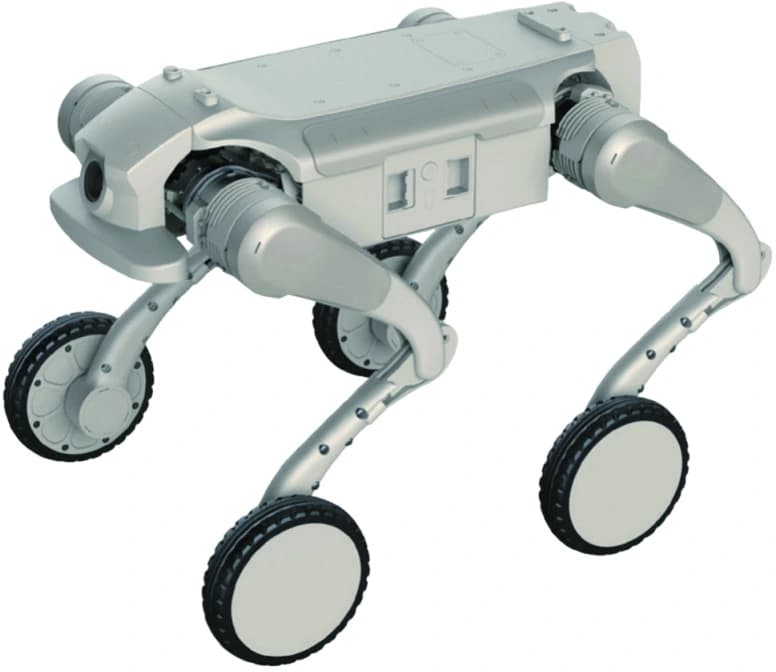
Four wheels. Articulated legs. A different way to approach a mobile-robot project. Explore Ultra-W with HRS for UK mobility research, route evaluation and supervised inspection trials.
PLATFORM FIT
Wheel-legged quadruped for mobility research and inspection trials, with 16 DOF, motorised wheel hubs and a manufacturer-rated 9 ± 1 km operating range. Choose it when the way the robot moves is central to the project, not simply because it carries the Ultra name.
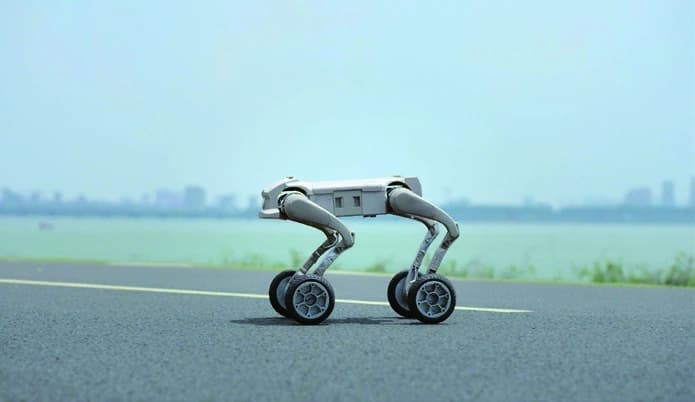
Ultra-W adds motorised wheel hubs and solid tyres to articulated legs. Assess rolling movement, turning space and surface transitions for the intended route. Wheels do not make every surface suitable or remove the need for supervision.
The dedicated specification lists four degrees of freedom per leg, 16 in total. This is a distinct configuration from the 12-DOF Ultra; request the correct wheel-control interfaces and robot model for your software project.
The current Ultra-W specification rates effective payload at 5 kg, the same as Ultra. Account for sensors, mounting and fitted equipment within that limit. A larger body or wheels are not evidence of a higher payload allowance.
CANDIDATE APPLICATIONS
Start with a measurable trial and a prepared operating area. These are potential project directions, not claims of existing HRS installations or unattended operation.
Study the relationship between wheel motion, leg posture and the supporting surface. Confirm the model-specific control interfaces and simulation files before designing an experiment.
Assess a controlled route with clear criteria for traction, turning, stopping and transitions. Test the surfaces and clearances you actually expect to use.
Evaluate camera viewing or a separately specified sensor package on a mobile base. Plan communications and data handling, with an operator supervising the activity.
Build a trial around a defined sensor and mounting arrangement. Check the complete payload, power draw, connectivity and effect on balance before motion testing.
SPECIFICATIONS
Manufacturer test figures. The user manual identifies its parameter table as Turbo test data. Range, runtime, speed, payload and stair height are separate ratings, not a promise of achieving them together. Practical results depend on terrain, movement, configuration, temperature and battery condition.
Sources: Ultra-W technical specification (English PDF), Ultra-W user manual (English PDF) and official Ultra-W flyer (English PDF).
Follow the manufacturer’s operating-mode and site-safety limits for the supplied robot.
The 9 ± 1 km range and 1–2 hour runtime describe different test measures. Plan the route, duty cycle and charging breaks together. The approximately one-hour charging figure covers 10–90%, not a full recharge; a replaceable battery does not establish powered hot-swap support.
IP54 is not a waterproof or all-weather guarantee. The manual calls for line-of-sight supervision and suitable ground, and warns against slippery or cluttered surfaces. Review clearances, stopping space and communications before choosing an outdoor route.
CONFIGURATION & DEVELOPMENT
The manufacturer lists SDK access, expansion interfaces and support for simulation environments such as Isaac Sim. Confirm the actual package and version for Ultra-W before building on it.
Request Ultra-W-specific firmware requirements, wheel commands and model files. Do not assume examples for a 12-DOF D1 can be used unchanged, or that a ROS integration is supplied.
The base specification lists a camera and IMU. LiDAR, depth cameras, RTK, cellular connectivity and application compute require separate confirmation, alongside mounting, power and data connections.
The manual describes a tracking mode in the controller app. That does not establish obstacle avoidance or unattended navigation. Confirm the installed features and scope any additional sensing, software and site testing.
If your main requirement is a legged teaching or control-research platform, explore D1 EDU. Its developer guide is a separate starting point, not proof of Ultra-W software compatibility.
CHOOSE YOUR PLATFORM
Ultra-W changes the mobility hardware, dimensions and weight. It does not increase the current published top-speed or effective-payload rating. Choose around the route and control requirements, then confirm the complete configuration.
| At a glance | D1 Ultra | D1 Ultra-W |
|---|---|---|
| Degrees of freedom | 12 DOF · 3 per leg | 16 DOF · 4 per leg |
| Standing size (L × W × H) | 630 × 360 × 420 mm | 630 × 430 × 485 mm |
| Weight incl. battery | 16 kg | 22 kg |
| Maximum speed | Up to 3.7 m/s | Up to 3.7 m/s |
| Effective payload | 5 kg | 5 kg |
| Ingress protection | IP54 | IP54 |
Need a larger equipment payload and base LiDAR? Compare Ultra-W with the industrial D1 Max.
For the legged model’s screen-controller and site-trial overview, read the D1 Ultra guide. For other quadruped configurations, see the full Lingxi D1 line.
HRS SUPPORT
HRS can help assess whether wheel-legged mobility fits the task and scope a demonstration. Agree the supplied hardware, development responsibilities and support before committing to a project.
Discuss surfaces, transitions, slopes, people and clearances. Define the operating area and practical criteria for the trial.
Check payload mounting, power, communications and the model-specific software package. Separate included equipment from integration work.
Scope operator familiarisation, stopping procedures and supervised testing. Confirm demonstration arrangements and the support responsibilities.
D1 Ultra-W FAQ
AGIBOT D1 Ultra-W is the wheel-legged model in the Lingxi D1 family. It combines articulated legs with motorised wheel hubs and solid tyres. The dedicated manufacturer specification lists 16 degrees of freedom, 22 kg including the battery and a 5 kg effective payload. HRS can assess it for UK mobility research, route evaluation and inspection-development trials.
Ultra-W has wheels and 16 DOF, compared with the legged Ultra’s 12 DOF. Ultra-W is listed at 22 kg and 630 × 430 × 485 mm standing; Ultra is 16 kg and 630 × 360 × 420 mm. Both current specification sheets list a 5 kg effective payload, up to 3.7 m/s and IP54 protection. Ultra-W is not specified as a double-payload or higher-top-speed version.
The manufacturer lists 9 ± 1 km of operating range and around 1–2 hours of runtime. These are separate test figures, not a guarantee of that distance with full payload at maximum speed. The manual identifies its parameter table as Turbo test data. Terrain, movement, payload, temperature and battery condition affect results. Allow around one hour to charge from 10% to 90%, not for a full recharge; powered hot-swap is not claimed.
AGIBOT rates D1 Ultra-W’s effective payload at 5 kg. Include the sensor, mounting and other fitted equipment in that allowance. Assess the proposed payload and mounting arrangement before a trial; the robot is not a passenger vehicle.
AGIBOT lists a continuous stair-climb height of up to 16 cm and IP54 protection. Neither figure guarantees suitability for a particular staircase, weather condition or route. The manual requires line-of-sight supervision and operation within 0–40°C, and warns against slippery or cluttered ground. Review the route, clearances, stopping arrangements and manufacturer instructions first.
The base specification lists a camera and IMU, SDK support and expansion interfaces; it does not establish LiDAR, a depth camera, RTK or cellular hardware as included. The manual describes an app tracking function, but this is not proof of obstacle avoidance or an unattended patrol system. Confirm the supplied software and scope any navigation, sensing and integration work separately.
Request the Ultra-W-specific SDK, firmware requirements, wheel-control interfaces and robot model files. AGIBOT lists support for development and simulation environments such as Isaac Sim. Do not assume a 12-DOF D1 EDU or Ultra example controls the 16-DOF Ultra-W unchanged, or that a ROS package and spare application compute are included.
Contact HRS with your route, surface conditions, proposed payload and timing. We can assess the platform fit, discuss a supervised demonstration and scope configuration planning, operator training and integration support. The supplied hardware, software features and availability are confirmed during the enquiry.
YOUR NEXT STEP
Share the route, proposed equipment and timing. HRS can assess the platform fit and discuss a UK demonstration.